
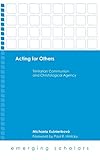
Acting for others : Trinitarian communion and christological agency / Michaela Kušnieriková ; foreword by Paul R. Hinlicky.
By: Kušnieriková, Michaela.
Material type: BookSeries: Emerging scholars: Publisher: Minneapolis Fortress Press 2017Description: xvii, 209 pages ; 24 cm.ISBN: 9781506423432; 1506423434.Subject(s): Arendt, Hannah, 1906-1975 | Bonhoeffer, Dietrich, 1906-1945 | Stăniloae, Dumitru | Arendt, Hannah, 1906-1975 | Bonhoeffer, Dietrich, 1906-1945 | Stăniloae, Dumitru | Church | Act (Philosophy) | Act (Philosophy) | ChurchDDC classification: 262.001 K962 Summary: This book explores why the metaphor of the church as a family is insufficient. In this, Arendt's concept of action and her criticism of privatizing the public political space by viewing it as a family are engaged through Bonhoeffer's ecclesiology and political theology and Stăniloae's triadology and theology of the world. The roots of the different views of Arendt and Bonhoeffer on family symbolism are traced to their distinct notions of acting. Human action becomes the central theme of the debate--particularly influenced by the Eastern Orthodox ecumenist Stăniloae and his vision of the communal relationship and interactivity of human subjects, and their place in the world. Synthesizing Bonhoeffer and Stăniloae, Christian calling is unfolded not only as acting for others, but also with others as Trinitarian participatory response--response to the words and deeds of the three divine Persons acting in communion. In being drawn into these unique relations, human beings are empowered for communal and common acting of equals participating in public-political issues. Since the family metaphor fails to articulate such acting, this study complements this symbolism with the metaphor of the church as a political community of solidarity--
| Item type | Current location | Call number | Status | Date due | Barcode |
|---|---|---|---|---|---|
 Book
Book
|
UBS LIBRARY General Book Section | 262.001 K962 (Browse shelf) | Available | 080390 |
Includes bibliographical references (pages 187-201) and index.
This book explores why the metaphor of the church as a family is insufficient. In this, Arendt's concept of action and her criticism of privatizing the public political space by viewing it as a family are engaged through Bonhoeffer's ecclesiology and political theology and Stăniloae's triadology and theology of the world. The roots of the different views of Arendt and Bonhoeffer on family symbolism are traced to their distinct notions of acting. Human action becomes the central theme of the debate--particularly influenced by the Eastern Orthodox ecumenist Stăniloae and his vision of the communal relationship and interactivity of human subjects, and their place in the world. Synthesizing Bonhoeffer and Stăniloae, Christian calling is unfolded not only as acting for others, but also with others as Trinitarian participatory response--response to the words and deeds of the three divine Persons acting in communion. In being drawn into these unique relations, human beings are empowered for communal and common acting of equals participating in public-political issues. Since the family metaphor fails to articulate such acting, this study complements this symbolism with the metaphor of the church as a political community of solidarity--
There are no comments for this item.